


There's no set age to stop using a baby monitor. Most families stop somewhere between 2 and 4 years old, when their child sleeps fairly well, can call out or come and find them, and sleeps close enough to be heard. Neither the NHS nor the American Academy of Pediatrics gives a stopping age; it's your call.
The better question is is my child ready, and am I? This guide gives you the signs to look for at each stage, a gentle way to step down instead of stopping overnight, and the times it's worth bringing the monitor back.
What official guidance says (and doesn't)
The health bodies talk about where your baby sleeps, not about monitors:
- The American Academy of Pediatrics recommends sharing a room with your baby, but not a bed, for at least the first 6 months.
- The NHS says the same: a separate cot or Moses basket in your room for every sleep for at least the first 6 months. For babies born early, follow safer sleep advice for a year from their due date.
- The Lullaby Trust says there is no research showing monitors help prevent SIDS, and that a monitor can never replace a parent or carer's supervision.
So a monitor isn't a safety device. It's a way to hear and see your child when you're in a different room. That's why the right time to stop depends on your home, your child and your own peace of mind, not on a birthday.
A rough timeline by age
Every child is different, but this is how monitor use typically changes:
| Age | Where your child usually sleeps | How useful a monitor is |
|---|---|---|
| 0–6 months | In your room, in their own crib or bassinet | For naps and evenings when you're elsewhere in the house |
| 6–12 months | Often moving to their own room | Most useful: night wakings are common and they can't call you |
| 1–2 years | Own room, usually still in a crib | Still useful, especially if their room is far from yours |
| 2–3 years | Crib or first bed; talking more | Many families start stepping down |
| 3–4 years | Bed; can call out or come to you | Most families have stopped or use it only for illness or naps |
A pediatrician quoted by Reviewed puts the typical stopping age at 2 to 4, and links it to two things: sleep habits and language. Once a child can say what they need, a monitor matters much less.
Signs your child is ready
Look for most of these, not all of them:
- They sleep fairly predictably. A settled routine, with night wakings that are rare and short.
- They can tell you what they need. Calling "Mommy!" or "Daddy, I need a drink" is the real milestone.
- They can come and find you. Once they're in a bed and can safely walk to your room, the monitor is mostly redundant.
- You'd hear them anyway. If their room is next to yours with doors open, you may not need help hearing them.
- They're not climbing out of the crib. Or, if they were, they've moved to a low bed in a childproofed room.
- They've noticed the camera. Toddlers who talk to it, wave at it or perform for it are often ready to stop.
Signs it's time for you to stop
Sometimes the monitor is the problem, not the child:
- It wakes you for nothing. Every rustle, cough or sleep-talk on the speaker breaks your sleep.
- You check it constantly. If you open the video again and again even when all is quiet, it may be feeding anxiety rather than easing it.
- You respond too quickly. Going in at the first whimper can stop a child learning to resettle on their own.
If this sounds familiar but you're not ready to stop, change how you use it (see the next section) before giving it up entirely. If worry about your child at night feels constant or overwhelming, talk to your doctor or health visitor; you're not alone and help is available.
How to step down gradually
Stopping overnight can be harder on parents than on children. A gradual plan, over a couple of weeks, usually works better:
- Stop watching, start listening. Keep the video off and only check it when you hear something.
- Switch to alerts only. Instead of an open sound feed all night, use a monitor that only alerts you to sustained crying, so ordinary noises don't reach you.
- Drop night-time monitoring first. You're usually closest at night. Keep the monitor for naps when you may be further away.
- Turn it off but leave it set up for a week. If nothing goes wrong, put it away.
- Replace it with something simple. Leave both bedroom doors open, add a dim night light so your child can find their way to you, and agree what they should do if they wake: call you or come to your room.
Tip
Explain the change to an older toddler: "You're big now, so if you need us, call out or come to our room." Children often feel proud of the new responsibility.
When to bring the monitor back
Many parents who've stopped still keep one in a drawer for:
- Illness, especially a fever, a cough or a stomach bug at night.
- Sleep regressions, nightmares or night terrors.
- A new sibling, or two children starting to share a room.
- A new house or a holiday rental, where the layout means you can't hear them.
- Moving from crib to bed, for the first few weeks while they get used to the freedom.
Using a phone as a step-down monitor
You don't need to keep a dedicated monitor for these occasional uses. If you have a spare iPhone or iPad, Dozi turns it and your own phone into a baby monitor that you can set up when you need it and put away when you don't. Both devices need to be on the same home Wi-Fi. It suits the step-down stage well:
- Cry alerts on your locked phone. You can lock your phone and only hear about sustained crying. A single cough or a toy falling over doesn't trigger an alert.
- Live video and sound whenever you open the app, so you can check in without going into the room.
- Back in action in seconds. Scan a QR code to pair; there's no account to set up.
- Nothing recorded, no cloud. The video goes directly between your two devices and never leaves your home.
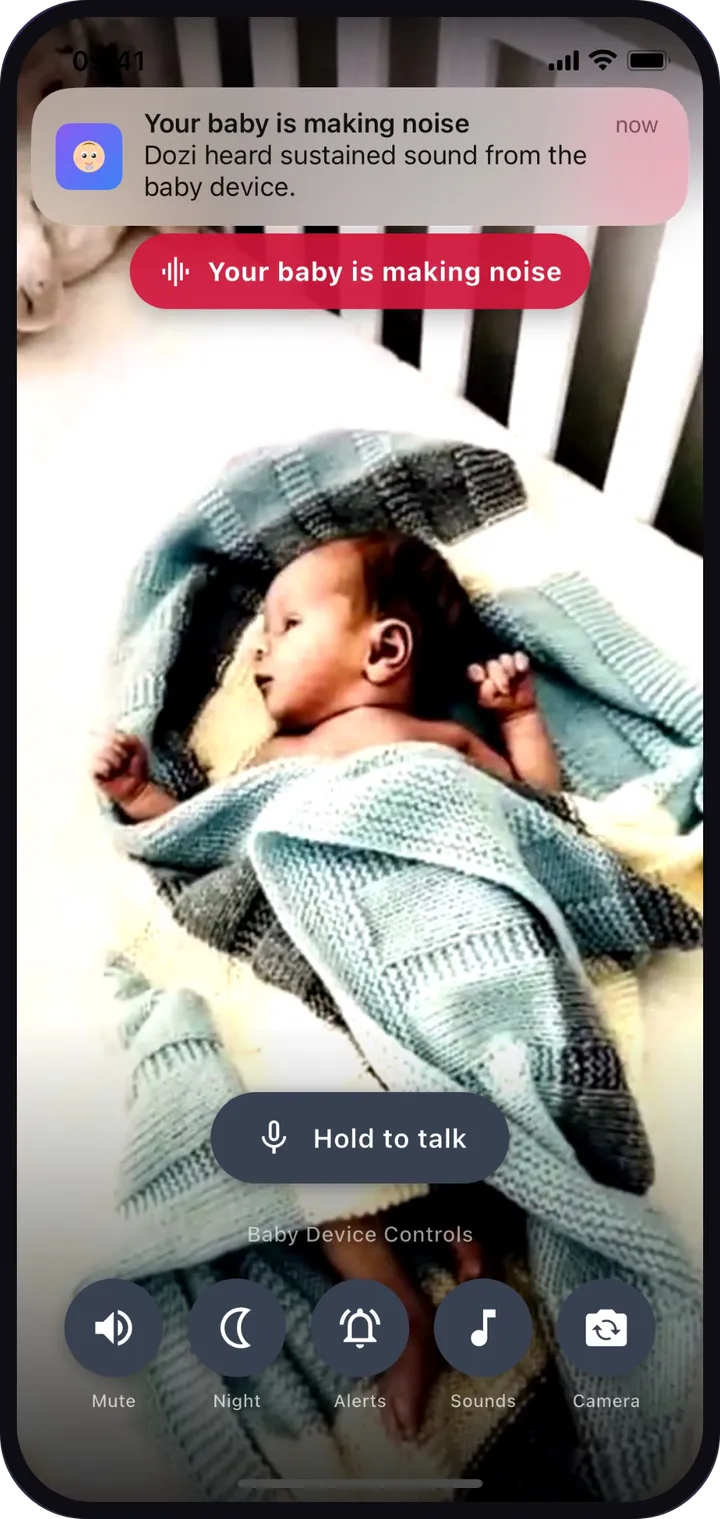
Dozi is free to download and free to try for 3 days. See how it works or read our guide to using an iPhone as a baby monitor. Like any monitor, it doesn't replace supervision or safe sleep practices.
The short version
- No official age: most families stop between 2 and 4.
- Follow safe sleep first: baby in your room for at least the first 6 months (AAP, NHS).
- Your child is ready when they sleep predictably and can call out or come to you.
- You might be ready sooner if the monitor is costing you sleep or adding worry.
- Step down gradually and keep a simple option for illness, travel and regressions.
Have another question? See the Dozi FAQ, or read about keeping a Wi-Fi baby monitor private.
Frequently asked questions
At what age can you stop using a baby monitor?
There is no official age. Many families stop somewhere between 2 and 4 years old, once their child sleeps fairly well, can call out or come and find them, and sleeps in a room close enough to hear. Some stop earlier, some keep one for naps or illness for longer.
Is there NHS or AAP guidance on when to stop using a baby monitor?
No. Neither the NHS nor the American Academy of Pediatrics gives an age for stopping. Both recommend that your baby sleeps in the same room as you for at least the first 6 months. The Lullaby Trust adds that monitors have not been shown to prevent SIDS and can never replace supervision.
Should I stop using the baby monitor at night first or for naps?
Most parents stop at night first, because they're in bed nearby and will usually hear a child who calls out. Naps are often the last to go, since you may be further away, outside or in the shower while your child sleeps.
Is it okay not to use a baby monitor at all?
Yes. A monitor is a convenience, not a safety requirement. If your baby sleeps in your room for the first 6 months, as the NHS and AAP recommend, and your home is small enough that you'd hear them cry, you may never need one.
Is it bad to leave a baby monitor on all night?
Not for your child, but it can be for you. If every snuffle and rustle wakes you, try a monitor that only alerts you to sustained crying, turn the volume down, or move the parent unit further from your bed.
Can my toddler tell they're being watched by the monitor?
Some older toddlers notice the camera and ask about it or play to it. If that's happening, it's often a sign they're ready to stop, or that it's time to explain what it's for and ask how they feel about it.
First published . This guide is general information, not medical advice.