

Yes, white noise is generally safe for babies when it is quiet, well away from the cot and not playing all day. The risk researchers have found is not the sound itself but the volume: many sleep machines can play louder than the level hospitals allow in newborn nurseries, especially at full volume right next to a baby's head.
So the practical answer is: keep it low (you should be able to talk quietly over it), keep it across the room, and use a timer where you can. The rest of this guide explains where those numbers come from, what the research does and doesn't show, and how to make sure white noise never stops you hearing your baby cry.
What the research says
Does white noise help babies sleep?
The evidence is modest but positive. In a small, frequently quoted 1990 study of 40 newborns, 16 of the 20 babies who heard white noise (80%) fell asleep within five minutes, compared with 5 of 20 (25%) without it. That study only measured how fast babies fell asleep, in babies a few days old. It doesn't show that white noise makes babies sleep longer or that it suits every baby.
Many parents find a steady sound helps by masking the things that wake a light sleeper: a dog barking, traffic, older siblings, a door closing. If your baby sleeps well in a quiet room, you don't need it.
Can white noise damage a baby's hearing?
The main warning comes from a 2014 study in Pediatrics by researchers at the Hospital for Sick Children in Toronto. They tested 14 infant sleep machines at maximum volume and measured them at 30 cm, 100 cm and 200 cm from where a baby would lie. According to the Children's Hospital of Philadelphia's summary:
- every machine was louder than 50 decibels, the recommended limit for hospital nurseries, at close range;
- several were louder than 85 decibels, the level at which adult workers must be protected;
- all but one were still above 50 decibels at 200 cm.
Two things are worth knowing. The study measured machines, not babies, so it didn't show that any baby lost hearing. And it tested them at full volume, which few parents use. What it does show is that "turn it up and put it on the cot rail" can be genuinely loud for a small baby's ears, and that some products allow it.
What does the American Academy of Pediatrics advise?
The AAP has no specific decibel limit for home white noise. Its guidance on noise and children says some infant sleep machines "can produce hazardous noise levels" and advises: "If you use a sleep machine, place it as far away from the baby's head as possible and use it for a short time only."
If your baby was born early, has had hearing problems or has a hearing check coming up, ask your paediatrician or health visitor before using white noise regularly.
How to use white noise safely
1. Keep the volume low
Aim for the quietest setting that still masks background noise. Hospital nurseries work to about 50 decibels, roughly the level of a quiet conversation. Two easy checks:
- The talk test: standing beside the cot, you should be able to talk quietly without raising your voice.
- The cry test: with the sound on, you must still be able to hear your baby cry, in the room and on your monitor.
If you'd like a number, a free sound meter app such as the CDC's NIOSH Sound Level Meter gives a rough reading at the cot. Phone microphones aren't lab equipment, so treat it as a guide.
2. Put it across the room
Distance makes a big difference to how loud a sound is at your baby's ears. Place the speaker or machine as far from the cot as your room allows, ideally on the other side. Never put it inside the cot, on the cot rail or clipped to the mattress, and keep cables well out of reach.
3. Use a timer
Following the AAP's "short time only" advice, the simplest approach is a sleep timer: let the sound play while your baby settles, then switch off. 30 minutes to an hour covers most settling. If your baby wakes easily at night from household noise and you choose to leave it on, keep it at the lowest volume that works.
4. Choose a steady, gentle sound
"White noise" is used loosely for any steady sound: hiss, rain, ocean waves, a heartbeat. A smooth, constant sound masks noise best. Avoid sounds with sudden peaks, and avoid anything that gets louder over time.
5. Don't let it hide crying
This is the risk that gets less attention than hearing. White noise is meant to mask noises from outside the room, but a loud machine can also mask your baby from you, especially with an audio-only monitor or one that alerts on any sound. Check that your monitor still picks up crying with the sound on.
Tip
Run a quick test: switch the white noise on at the level you'll use, then play a crying sound or talk at the cot while someone listens on the parent unit in another room.
Using a phone or tablet for white noise
You don't need a dedicated machine. A spare iPhone or iPad can play white noise in the nursery, and the same rules apply: phone speakers can be loud, so turn the volume down, keep the device out of reach and away from the cot, and test the level before you leave.
If you use Dozi as your baby monitor, the device in the nursery can play the sounds too, so one spare device does both jobs:
- Five soothing sounds: white noise, rain, ocean waves, heartbeat and lullaby.
- Volume control from your phone, so you can turn it down without going back into the room.
- A sleep timer of 15 minutes, 30 minutes or 1 hour, so the sound stops on its own.
- Live video and audio on your phone, so you can check on your baby whenever you like.
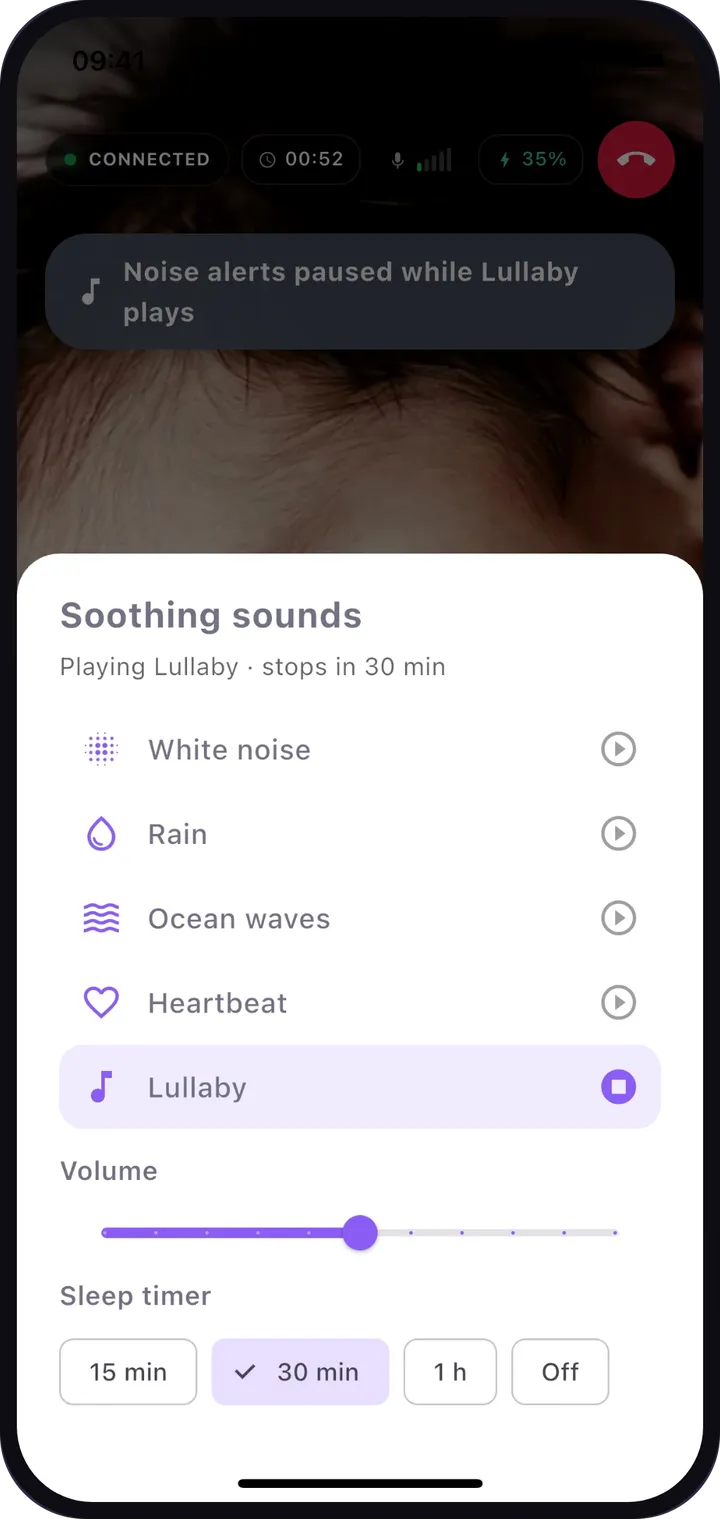
One thing to know: Dozi pauses cry alerts while one of its soothing sounds is playing, so the sound isn't mistaken for crying. That's another good reason to use the sleep timer: when the sound stops, cry alerts come back on. If you prefer a separate white-noise machine that runs all night, Dozi learns steady background noise like that and still alerts you when crying keeps going. You can read more about cry alerts and sounds on the features page, or see how to set up an iPhone as a baby monitor.
Dozi is not a medical device. It doesn't measure sound levels or protect hearing; how loud the sound plays is up to you.
When to stop using white noise
There's no set age. Many families use it through the toddler years; others drop it once their baby sleeps through. If you want to stop:
- Lower the volume a little each night over a week or two until it's off.
- Shorten the timer so the sound fades out sooner after your baby falls asleep.
- Try a quieter, gentler sound first if your baby relies on it heavily.
Expect a few unsettled nights. If sleep problems carry on, talk to your health visitor or paediatrician.
The short version
- White noise can help babies settle, though the research is small.
- The risk is volume: keep it quiet enough to talk over and far from the cot.
- The AAP advises placing sleep machines as far from the baby's head as possible and using them for a short time only, so a timer is a good default.
- Make sure you can still hear your baby cry with the sound on.
Got more questions about using a phone as a monitor? See the Dozi FAQ.
Frequently asked questions
Is white noise bad for a baby's hearing?
It can be if it is too loud or too close. A 2014 study in Pediatrics found that many infant sleep machines at full volume and close to the cot were louder than the limit used for hospital nurseries. At a low volume and well away from your baby, there is no evidence that white noise harms hearing. The American Academy of Pediatrics advises placing any sleep machine as far from the baby's head as possible.
How loud should white noise be for a baby?
As quiet as still works. No health body has set an official limit for home white noise, but hospital nurseries aim for about 50 decibels, roughly the level of a quiet conversation. A simple check: standing at the cot, you should be able to talk quietly over it, and you must still be able to hear your baby cry.
How far away should a white noise machine be from a baby?
As far as practical, ideally across the room. In the 2014 Pediatrics study, almost every machine was still louder than the nursery limit at 2 metres (about 6.5 feet) when played at full volume, so distance alone is not enough; keep the volume low too. Never put the machine or its cable in the cot or on the cot rail.
Is it okay to play white noise all night?
Experts disagree. The American Academy of Pediatrics advises using sleep machines for a short time only. A sleep timer that switches the sound off once your baby is asleep follows that advice. If you do leave it on longer, keep it at the lowest volume that works and well away from the cot.
Can babies become dependent on white noise?
Some babies get used to it as part of their sleep routine, which is not harmful in itself. If you want to stop, lower the volume a little each night over a week or two, or use a timer so the sound fades out after your baby falls asleep.
Can I use my phone to play white noise for my baby?
Yes, but phone speakers can get loud, so turn the volume down, keep the phone out of reach and away from the cot, and check the level before you leave the room. Use a spare phone or tablet in the nursery so your own phone stays with you.
First published . This guide is general information, not medical advice.